
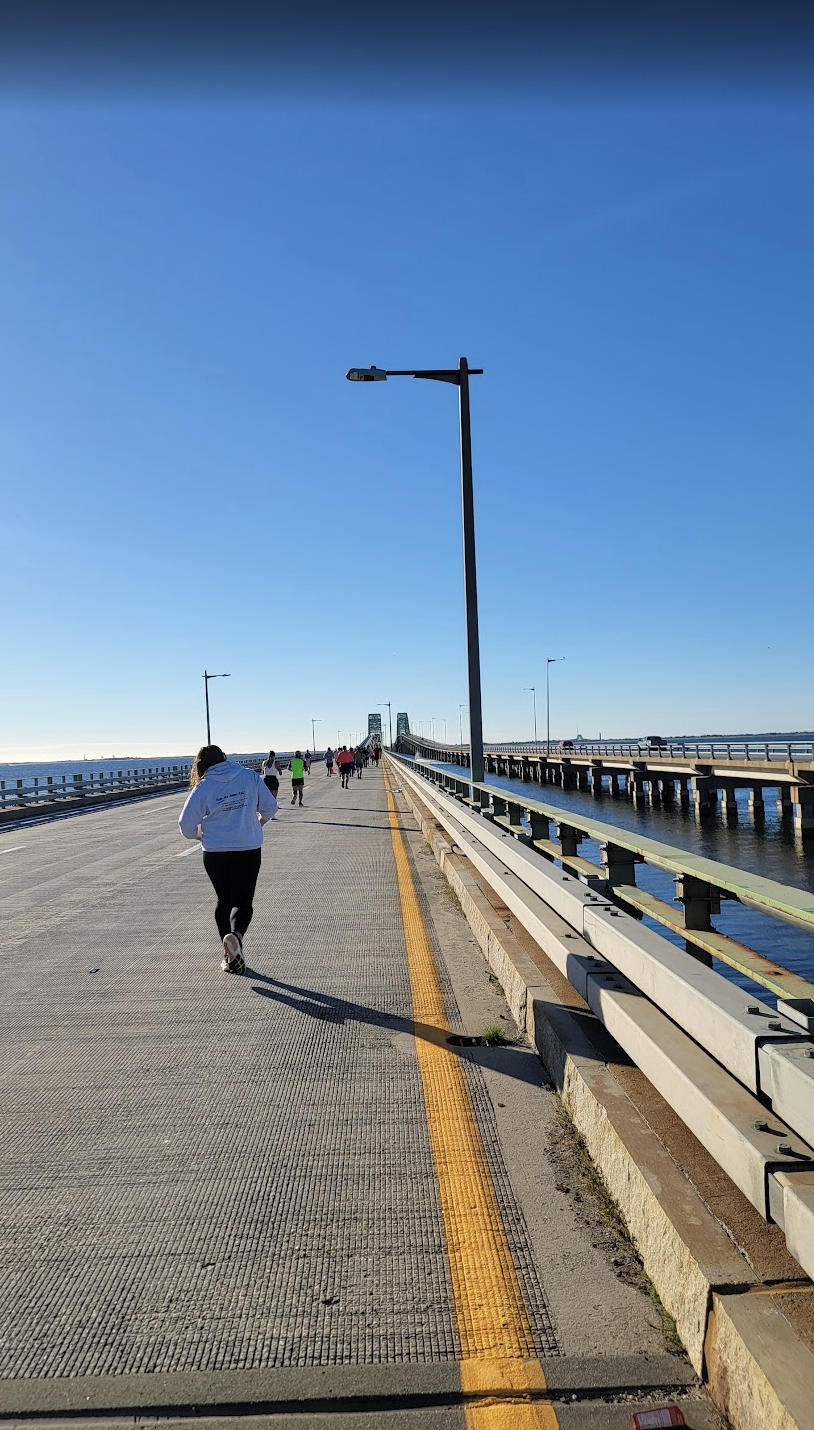
Somewhere around mile 20 of the Suffolk County Marathon this past Sunday, I had a realization: my hamstrings were not going to loosen up.
I started doing the math.
The course closed in 7 hours. I checked my watch and figured that even if I walked every single remaining step, I'd still make it across the line. That was a relief, because I'd come into the race with two goals. Goal #1 was to finish. Goal #2 was to beat my time from two years ago.
I got one out of two.
I finished in 6 hours and 30 minutes, which is half an hour slower than my first marathon. I'd be lying if I said that didn't sting a little. But I've had a few days to think about it (mostly while hobbling around my house), and I came away with four lessons I think are worth sharing, whether or not you ever plan to run 26.2 miles.

1. A cramp and overuse are different
I actually had two very different kinds of trouble in this race.
The first came at mile 8. Out of nowhere, my right quad seized up. Mile 8 is a distance I run comfortably, so it caught me off guard. But it was in one spot, it came on suddenly, and I was able to work it loose without even stopping. A few minutes later I was fine.
The second came at mile 18, and it was a whole different animal. Both hamstrings started to feel inflamed. It didn't hit all at once. It crept in, and no amount of shaking them out made a difference. It just kept building.
The first one was a cramp. That's a muscle contracting on its own and refusing to let go. Fatigue is a common trigger, and gentle movement or stretching can usually coax it to release.
The second one was overuse. That's what happens when you ask your tissue to do more than it's been prepared for. Small amounts of stress pile up faster than your body can repair them, and the result is inflammation.
And here's the key difference: overuse needs rest, not more motion.
Why does this matter? Because the two call for opposite responses. Working through a cramp is often totally reasonable. Pushing hard through overuse is how a rough day turns into a long recovery.
If you're ever trying to figure out which one you're dealing with, here's a rough guide:
Sudden, in one spot, and it eases when you move: more likely a cramp or a minor strain
Gradual, often on both sides, and it gets worse the longer you go: more likely overuse
Sharp pain, a pop, bruising, or trouble putting weight on it: stop and get it looked at
Now, full honesty — I kept going on my hamstrings. Finishing mattered to me, and I had enough time on the clock to walk it in. That was a calculated choice I made for myself, not something I'd recommend. If you're ever unsure which one you're dealing with, slowing down is almost always the safer bet.
2. Race day found the limit my training didn't
My longest training run was 12 miles. And where did the serious trouble start? Mile 18. Six miles past anything I'd actually practiced.
In hindsight, that makes total sense. A longer training run probably would have shown me exactly where my hamstrings and quads tapped out, weeks before race day, while I still had time to train.
I like to think of training as a series of rehearsals. Every long run teaches your muscles, tendons, and energy systems what to expect, and they adapt to that load. So when race day asks for more than double the distance you rehearsed, your body is basically improvising.
To be clear, you don't need to run the full distance before race day. Most training plans don't have you do that. But narrowing the gap between your longest run and the race does two really useful things. It strengthens your tissues, and it shows you your weak spots while there's still time to work on them.
This applies way beyond running, by the way. Whether you're getting ready for a long hike, a busy season at work that keeps you on your feet, or picking up your kids for the next ten years, your body gets ready for what you actually practice.
3. Doing something before doesn't mean you'll do it better
This was my second marathon. Going in, part of me assumed it would go better than the first. I'd done it before, right? I knew what to expect.
Then I finished 30 minutes slower.
It turns out that having done something before doesn't automatically mean you'll do it better. And honestly, I see this in my practice all the time.
Someone comes in who's lived with back pain for ten years. They know that pain inside and out. They know what sets it off, what time of day it's worst, which chair to avoid. But knowing your pain really well isn't the same as getting better.
When I look back, the reasons I was slower aren't mysterious. Two years passed between my races. My training was different. My body is two years older. Experience told me I could finish. It didn't tell me I was ready to finish faster.
The same is true if you're recovering from an injury or managing a chronic condition. What worked last time is a good starting point, but it's not a guarantee. Each new attempt deserves its own honest look at where you are today, not where you were the last time you tried.
4. Everyone runs for a different reason
One of my favorite parts of any race is the people you meet along the way.
This time, I spent part of the course talking with the number 2 college wrestler in the nation. I also met a woman whose entire reason for signing up was simply, "Why not?"
Same 26.2 miles. Completely different reasons for being out there.
Mine are personal. My maternal grandmother had dementia. My father has had several stents placed in his heart and legs. And some of the most heartbreaking stories I hear in my office come from patients who lost their sense of who they are after a sudden stroke.
Regular aerobic exercise is one of the best tools we have to lower the risk of all three. That's a big part of why I lace up.
I also run because I want to live longer, and there's a number that helps me track that: VO2 max. It's the amount of oxygen your body can use during hard effort, and it's one of the strongest predictors of lifespan we know of.
Over this training cycle, mine went from 34 to 50.
Now, that number comes from my watch, which isn't as precise as a proper treadmill test. But the trend is clear. My race was slower, but the engine underneath it got a lot stronger. I'll take that trade.
These reasons are all connected, too. Aerobic exercise improves blood flow to your brain and helps keep blood pressure, cholesterol, and blood sugar in check. Those same factors drive heart attacks, strokes, and many forms of dementia. VO2 max is just a measurable way to see how well that whole system is working.
And here's the encouraging part: VO2 max responds to training at almost any age. You don't need to run a marathon to improve it. Brisk walking, cycling, swimming, or anything that gets you breathing hard on a regular basis counts.
Your reason might be competition, curiosity, or your family history. It doesn't really matter which. What matters is that you know it, because that's what gets you out the door on the days you don't feel like going.
How I'm recovering
The day after the race, I was so sore I could barely bend or straighten my knees. Getting in and out of a chair was an event.
The next day was noticeably better. And by the day after that, the soreness had nearly cleared up.
Here's what I've been doing:
Drinking more water. About 3 liters a day instead of my usual 2.
Keeping things moving. Gentle range-of-motion movements throughout the day to keep my quads and hamstrings warm.
Soreness that peaks a day or two after a hard effort and then fades is completely expected. It's a sign your muscles are repairing.
What I watch for is anything that breaks that pattern:
Pain that gets worse after the second or third day
Swelling
Sharp pain in one specific spot
If you notice any of those after a hard workout, that's worth a closer look.
Visit Paragon Osteopathy in Parsippany
Whether you’re training for your first race, dealing with soreness that won’t go away, or not sure if that ache is a cramp or something more, Paragon Osteopathy is here for the Parsippany and Northern New Jersey community. I’ll help you figure out what’s actually going on and build a plan to get you moving again.
Telehealth visits are also available if getting to the office isn’t convenient for you.
Ready to get started? Click here to schedule your first visit or a free consultation with me.
